
DNA could become an alternative for storing digital information thanks to its extraordinary ability to preserve data in extremely small spaces.
The amount of digital information we generate keeps growing. Photos, videos, documents, databases, and business files need more and more storage space.
Right now, a big part of that information is kept on hard drives, solid-state drives, and data centers. However, these systems have limits when it comes to capacity, energy use, and long-term preservation.
Faced with this challenge, researchers are exploring an amazing alternative: using DNA molecules to store digital information.
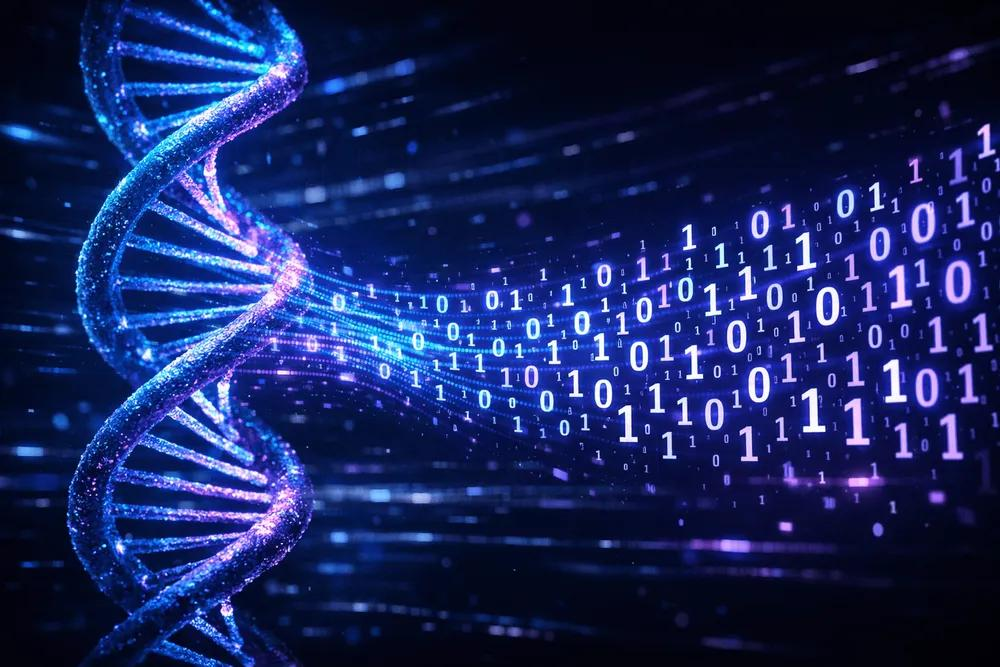
How can DNA store information?
DNA is a biological molecule that contains genetic information through four fundamental components, known as nitrogenous bases:
- Adenine (A).
- Thymine (T).
- Cytosine (C).
- Guanine (G).
DNA storage technology uses these four bases to represent digital information.
The process works like this:
- Conversion: digital files are turned into sequences represented by A, T, C, and G.
- Synthesis: DNA molecules containing the corresponding sequences are produced.
- Storage: the molecules are kept under controlled conditions.
- Reading: biological information is retrieved using sequencing techniques.
- Reconstruction: the sequences are converted back into digital files.
In this way, a biological molecule can function as a physical medium for storing data.
Why use DNA instead of hard drives?
One of its main advantages is storage density: DNA can hold large amounts of information in very small volumes.
It also has the potential to store data for long periods when properly preserved.
Among its possible advantages are:
- High storage density.
- Potential for long-term preservation.
- Reduction of the physical space needed for certain files.
- Possibility of using biological materials as storage media.
A breakthrough that connects biology and technology
In November 2026, a study published in Nature introduced AutoDNA, an autonomous lab capable of running a digital information storage cycle in DNA and retrieving the exact original content.
The development integrated DNA synthesis, amplification, and sequencing operations through different automated instruments.
This result is especially interesting because it shows how biotechnology and artificial intelligence can be combined to develop new storage methods.
What applications could it have?
Molecular storage could be used in:
- Historical files: preservation of important documents and records.
- Research centers: storage of large sets of scientific information.
- Institutions: preservation of archives that need to be kept for decades.
- Data centers: exploring new alternatives to store information long-term.
Why hasn’t it replaced hard drives yet?
Despite its potential advantages, this technology still faces significant limitations.
DNA synthesis and reading can be expensive and slow compared to conventional devices. There are also challenges related to reading errors, accessing specific data, and scalability.
That’s why its most promising application right now is related to storing information that needs to be kept for long periods, not replacing the disks used every day.
Referencias
- Nature. (2026, 4 de noviembre). An AI-native experimental laboratory for autonomous biomolecular operations. Consultar investigación original.
- Nature Reviews Chemistry. (2026). The past, present and future of self-driving laboratories. Consultar investigación.
- McKinsey & Company. (2026). Technology Trends Outlook 2026. Consultar informe.