
Over the past few years we have become accustomed to interacting with artificial intelligence in a fairly simple way: we ask a question and receive an answer. However, this dynamic is beginning to change.
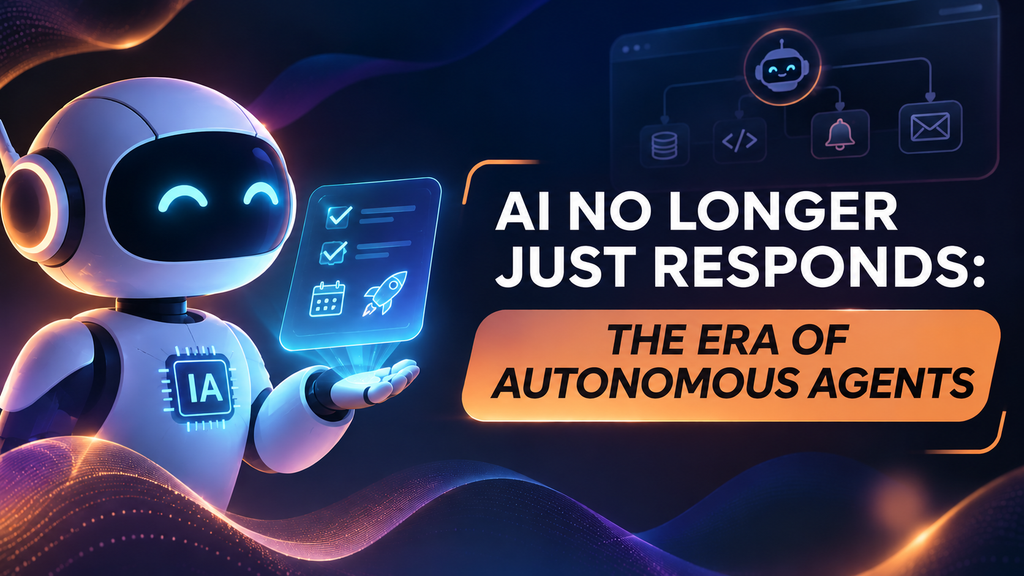
The next stage of artificial intelligence is not just about generating text, images, or code. The goal is to create systems capable of understanding a goal, deciding what actions they need to take, and using different tools to achieve it. This is where so-called artificial intelligence agents come into play.
From answering questions to performing tasks
A traditional chatbot works primarily based on instructions. A person makes a request, the system processes the request, and generates a response. An AI agent can take this concept a step further.
Let’s imagine that someone needs to plan a trip. Instead of asking an AI one by one about available destinations, flights, places to stay, and activities, they could simply set a goal:
“Help me organize a five-day trip within this budget.”
An agent-based system could break that goal down into different tasks: researching destinations, comparing options, checking available information, arranging alternatives, and presenting an itinerary. Depending on the tools and permissions available, some systems may even interact with external applications to perform certain actions. The difference seems small, but it represents an important change: AI is no longer limited to producing information and is beginning to participate in processes.
How does an AI agent work?
Although there are different architectures, many agents operate according to a relatively simple cycle.
First, they are given a goal. Then they analyze the situation and determine what they need to do to move forward. Next, they can use external tools, consult information, analyze results, and decide what the next step should be. The process can be repeated several times until the established goal is achieved or until human intervention is necessary. For example, an agent tasked with analyzing a technical problem might:
- Receive a fault report.
- Review system logs.
- Identify abnormal behavior.
- Search for related information.
- Come up with a possible explanation.
- Propose actions to resolve the problem.
- Request authorization before taking any sensitive action.
This makes it possible to imagine AI systems that collaborate much more actively within organizations.
An AI can also use tools
One of the most important features of agents is their ability to connect with other tools.
An AI model alone has limited capabilities. But when you can interact in a controlled way with databases, browsers, business systems, APIs, calendars, or internal applications, your possibilities increase considerably. In a company, for example, an agent could analyze requests received by support, classify them, and query related information before suggesting a response. Another might review operational metrics and detect behaviors that require attention.
The goal is not necessarily to eliminate human involvement, but to automate repetitive tasks so that people can focus on decisions that require more judgment.
From a single agent to teams of agents
Another option is to use multiple specialized agents. Instead of having a single artificial intelligence system try to solve the entire problem, different agents can handle specific tasks. One could research information, another analyze data, and a third review the results before reaching a conclusion. It’s similar to dividing a project among different team members. This concept, generally known as multi-agent systems, is opening up new possibilities for automating complex processes. However, it also introduces new challenges.
More autonomy also means more responsibility
Allowing an AI to perform actions requires much tighter controls than simply allowing it to generate text.
- What happens if you misinterpret an instruction?
- What tools should you be able to use?
- What information can you access?
- What actions require human authorization?
These questions are fundamental. An agent with too many permissions could perform incorrect actions, while an excessively limited agent could lose much of its usefulness. Therefore, concepts such as minimum permissions, activity logs, validations, and human supervision take on special importance.
The human continues to be part of the process
Autonomy does not necessarily mean eliminating people. In many scenarios, the most useful model may be one in which artificial intelligence does the legwork and a person retains control over important decisions.
For example, an agent might detect a problem, gather information, and propose a solution, but wait for authorization before modifying a system. This approach combines the speed of machines with human judgment and accountability.
A new way to use artificial intelligence
For a long time, we thought of artificial intelligence as a tool we turned to when we needed information.
Agents are changing that mindset. Instead of asking ourselves only, “What can AI answer?”, we’re starting to ask, “What tasks can it help us complete?”
That small change could profoundly transform the way we use software. Artificial intelligence is evolving from a tool that waits for instructions to, little by little, becoming an active participant in our digital processes. And we’re probably just seeing the beginning.
What happens when an AI makes a mistake with great certainty?
Imagine asking an artificial intelligence a question and receiving a perfectly worded answer. It includes dates, names, explanations, and even technical terms. Everything seems correct. There’s just one small problem: some of the information never actually happened.
This phenomenon is one of the most interesting challenges in generative artificial intelligence and is commonly known as AI hallucination. The concern is not merely that an AI might make a mistake—any system can do that. The real problem is that it can present incorrect information with exactly the same apparent certainty with which it presents true information.
An AI doesn’t “know” things like we do
To understand why this happens, it is necessary to abandon a fairly common idea: language models do not work like huge encyclopedias that simply look for a stored answer.
Its operation is different. These systems have learned existing patterns in enormous amounts of information and use those patterns to generate a likely continuation of the content they receive. In a simplified way, when we write: “The capital of France is…” the model can determine that an extremely likely continuation is “Paris”. But as questions become more specific, ambiguous, or poorly documented, finding a suitable continuation becomes more complicated.
And that’s where a problem arises. The model can generate a linguistically convincing response, even if the information behind it is incorrect.
When inventing seems to answer
Let’s say we request information about an academic study that doesn’t actually exist.
A model might recognize how academic references are typically written: authors, titles, journals, years, and publication numbers. If you do not have adequate mechanisms in place to verify the information, you could produce a reference that has all the appearance of being authentic.
The result may include:
- A perfectly credible title;
- Names of researchers;
- A supposed scientific journal;
- A publication date;
- And even an explanation of the results.
Everything might seem legitimate, and yet be completely made up.
This demonstrates a fundamental difference between generating plausible information and proving that a statement is true.
Why doesn’t he just say “I don’t know”?
Modern models can be trained to recognize uncertainty and avoid providing an answer when there is insufficient information.
However, achieving this perfectly is difficult. The basic goal of a language model is to generate a useful and coherent response to a prompt. Under certain circumstances, this ability can cause it to fill in gaps using learned patterns.
That is why a detailed, technical, and perfectly written answer should not automatically be considered true.
The quality of the writing does not guarantee the quality of the information.
The problem increases when we use AI to work
An incorrect date in a casual conversation probably won’t have any major consequences. But let’s consider other scenarios. A person uses AI to interpret technical documentation and is given a nonexistent function. An employee requests information about an internal policy and is given a made-up procedure.
A developer receives code that incorrectly uses a library. An analyst receives statistics that appear legitimate but were never verified. In these scenarios, an incorrect response can ultimately lead to a wrong decision. That’s why hallucinations aren’t just a technical problem. They also represent an issue related to how we use and trust artificial intelligence.
Provide access to verifiable information
One strategy for mitigating this problem is to provide the model with information sources it can consult.
For example, a company can connect an AI system to its internal documentation.
When someone asks a question, the system first retrieves relevant documents and then uses that information to construct the answer.
This approach is commonly known as RAG (Retrieval-Augmented Generation).
Instead of relying solely on what it learned during training, the model obtains additional context from specific sources.
This can significantly improve accuracy, although it does not completely eliminate the possibility of errors.
Tools can also help
Another strategy is to allow AI to use specialized tools. If you need to perform a mathematical operation, you can use a calculator. If you need recent information, you can consult an updated source. If you need to know the status of a system, you can get the data directly from an authoritative tool.
The idea is simple:
not forcing the model to “remember” or generate information when there is a tool capable of verifying it.
This combination of language models, information retrieval, and external tools is making it possible to build much more reliable systems.
We also need to learn how to use AI
Technology may improve, but user behavior is also important. When an answer has significant consequences, verification remains essential.
We can ask for sources, compare information, review official documentation, and use artificial intelligence as a tool to aid our research rather than automatically treating it as the final authority.
We must also be mindful of a deceptive aspect of these systems: an incorrect answer can sound remarkably convincing.
Humans tend to associate certainty with knowledge. With artificial intelligence, that relationship does not always hold true.
Trust, but verify
Generative artificial intelligence can explain concepts, summarize large amounts of information, assist with programming, analyze documents, and speed up numerous tasks.
But using it correctly also requires understanding its limitations. Probably the most important question when we receive a response from an AI shouldn’t just be:
“Sounds right?”
We should also ask ourselves:
“How can I prove that it really is?”
Because in an age where machines can produce increasingly convincing answers, learning to distinguish between a good explanation and a proven fact will be an increasingly important skill.