

“When the sky is filled with passengers, the real challenge isn’t flying… it’s responding.”
The airline industry is one of the most demanding sectors in the world in terms of customer service. Cancellations, itinerary changes, complaints, refunds, lost luggage, mobile check-in, last-minute inquiries… everything happens in real time and under pressure. For years, many airlines operated with fragmented systems: one call center for voice, another provider for social media, isolated platforms for email and airport service.
That model no longer works.
One notable case is that of Akasa Air, an airline that decided to make a strategic shift: abandoning technological fragmentation and migrating to a 100% cloud-based omnichannel CCaaS (Contact Center as a Service) model.
The problem: multiple channels, an inconsistent experience
Before the transformation, the challenge was common in the sector:
- Passenger information scattered across different systems.
- Long wait times during periods of high demand.
- Difficulty scaling operations without investing in infrastructure.
- Disconnected experiences between digital channels and face-to-face (F2F) service.
In an industry where every minute counts, not having a unified view of the customer creates friction. And in aviation, friction translates into public dissatisfaction.
“The customer doesn’t think about channels; they think about solutions.”
The strategic decision: unify everything in the cloud
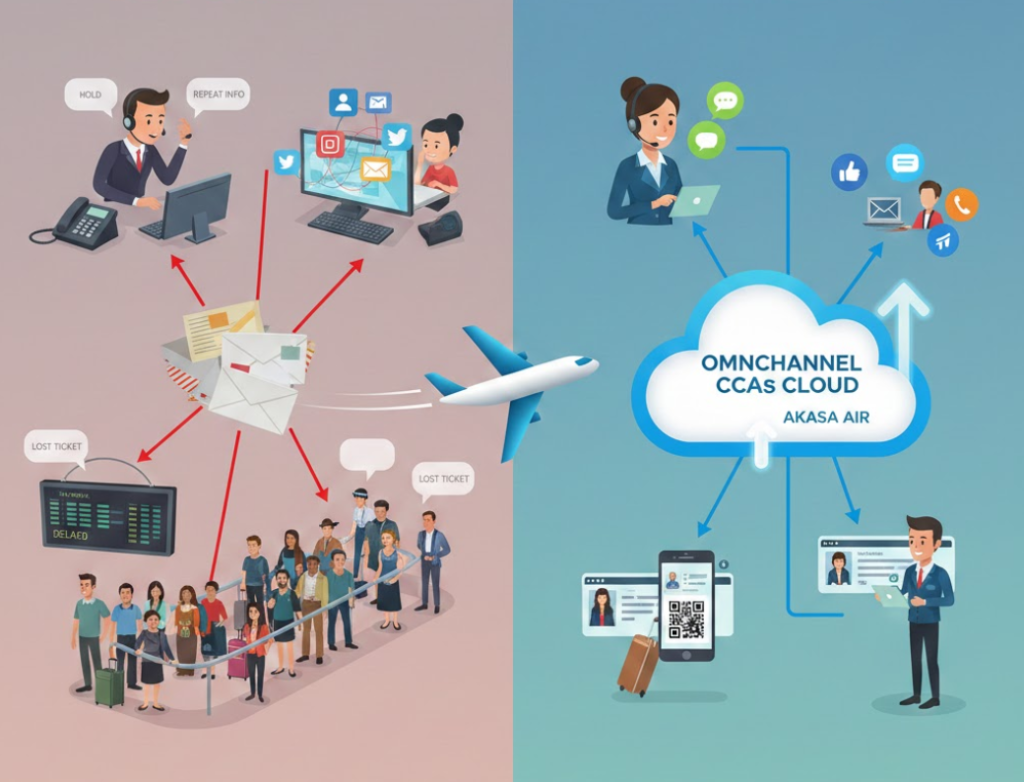
The airline opted for an omnichannel cloud platform that integrated:
- Voice
- Chat
- Social media
- Messaging
Everything centralized in a single environment accessible from mobile devices and remote workstations.
The big difference was not only technological. It was operational.
By eliminating on-premise infrastructure, the company achieved:
✔ Immediate scalability during peak seasons.
✔ Faster implementation without purchasing hardware.
✔ Reduced maintenance costs.
✔ Greater mobility for agents and supervisors.
“No local servers, no physical limits: the service travels as fast as the passenger.”
Operational impact: measurable efficiency
The CCaaS model enabled:
- Real-time access to the passenger’s complete history, regardless of the channel.
- Seamless transition between digital interaction and face-to-face service at the airport.
- Optimization of human resources based on demand.
During peak periods, such as holidays or special events, responsiveness could be dynamically adjusted, something that is difficult to achieve with traditional contact centers.
In addition, centralized visibility made it possible to detect frequent query patterns and redistribute resources without the need for physical expansions.
The passenger experience: total consistency
One of the biggest benefits was consistency in the customer experience.
A passenger who starts a chat conversation can continue it by phone without repeating information. If they go to the airport, F2F staff have access to the previous context.
That’s true omnichannel retailing.
This case demonstrates something crucial: the cloud model is not a technological trend, it is a strategic competitive advantage.
Airlines operate in highly regulated and complex environments. Adopting omnichannel solutions without local infrastructure not only reduces costs but also improves operational resilience.
“When infrastructure ceases to be a burden, the experience becomes the focus.”
For any transportation, tourism, or mobility company, the lesson is clear: customer service can no longer depend on silos. Customers are on the move. Services must move with them.