

Summary
The adoption of artificial intelligence in sectors such as human resources, banking, and healthcare has transformed the way organizations make strategic decisions. However, the growth of these systems has also highlighted a critical risk: algorithmic bias.
When AI models are trained with incomplete or historically discriminatory data, they can replicate and amplify inequalities on a large scale. In this scenario, companies face the challenge of developing technological solutions that are not only efficient but also transparent, auditable, and ethically responsible.
This article looks at how biases arise in artificial intelligence models, the business impact of these flaws, and the technical strategies currently used to build more fair and reliable systems.
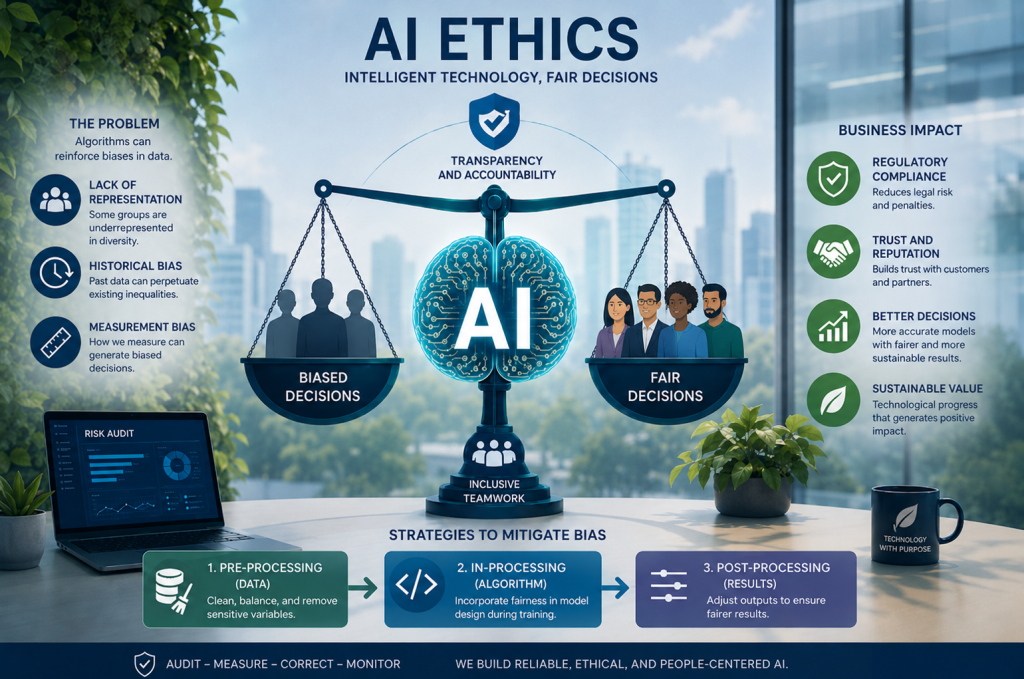
INTRODUCTION
Artificial intelligence is no longer a technology of the future; today it decides who qualifies for a bank loan, which resume moves forward in a hiring process, or how medical resources are distributed. There’s a widespread belief that, because it’s based on math, software is inherently neutral. However, AI learns from the past. If historical data reflects discrimination or lack of representation, the system will learn and automate those same mistakes on a large scale. Ethics in software development has become a critical skill for IT engineers, who need to ensure that technology is fair and just.
Origin and types of bias in data
Algorithmic bias doesn’t just pop up on its own; it gets introduced at different stages of the development lifecycle:
- Representation bias: This happens when the training sample doesn’t reflect the diversity of the real population. For example, if a facial recognition system is trained 80% on faces from a single demographic group, its error rate will skyrocket when analyzing minorities.
- Historical bias: This happens when data reflects existing social inequalities. A hiring algorithm trained on a company’s history, which historically didn’t hire women for executive positions, will conclude that women are less suitable candidates.
- Measurement bias: It happens when the metrics chosen for training are distorted or favor a specific outcome due to poorly controlled external factors.
Consequences of unethical practices in development
Developing software with algorithmic biases represents much more than a technical problem. Automated decisions can directly impact corporate reputation, customer trust, and regulatory compliance.
Among the main consequences for organizations are:
- Legal and regulatory risks.
- Loss of user and customer trust.
- Incorrect operational decisions.
- Increased costs due to system redesign.
- Reputational damage associated with technological discrimination.
- In highly regulated sectors, such as healthcare or financial services, the transparency and auditability of algorithms have become fundamental requirements to ensure responsible operations.
Technical strategies for mitigating bias
Current developers have specific methodologies for intervening in models at three different levels:
- Pre-processing (Data): This involves balancing the datasets before training the model. This includes techniques such as resampling (increasing the representation of minority groups) or removing sensitive variables that may be indirectly correlated with protected data.
- In-processing (Algorithm): This involves modifying the model’s loss function during training, adding mathematical fairness constraints (such as demographic parity) to penalize discriminatory predictions.
- Post-processing (Results): Adjust the model’s decision thresholds once trained to ensure that the final results are distributed fairly among the different groups.
Currently, there are open-source libraries specializing in the detection of these flaws, such as Fairlearn and AI Fairness 360 (AIF360), which allow engineers to perform quantitative fairness audits directly in their development environments.
CONCLUSION
Building ethical artificial intelligence is not a problem to be solved solely by the social sciences, but also by the lines of code. As future professionals in the field of information technology, we have the technical responsibility to implement rigorous data audits. Designing efficient software is no longer enough; the true challenge for our generation is to ensure that the systems we build are technically sound, transparent, and socially just.
REFERENCES
- García, A. (2024). Ethics of code: Transparency and justice in the age of algorithms. University Editions.
- Martínez, S., & Torres, L. (2025). Analysis of open source tools for bias detection in machine learning models. Ibero-American Journal of Software and Artificial Intelligence, 18(1), 89-104.
- O’Neil, C. (2023). Weapons of Math Destruction: How Big Data Increases Inequality and Threatens Democracy (Trans. J. C. Santos). Captain Swing.